Empowerment Syrian Refugees Widows and Capacity Development in Plumbing, Gray Water Treatment, and Reuse in Agriculture (ESWP)
Problem Statement
Northern Jordan, particularly Ramtha and Irbid, hosts a large population of Syrian refugees, many of whom are widows living without a stable source of income. These vulnerable women, along with underprivileged Jordanian youth, face significant barriers to employment due to limited access to marketable technical skills and training opportunities. In parallel, Jordan suffers from severe water scarcity and high leakage rates — up to 50% — due to inadequate plumbing services. This context presents a dual challenge: addressing unemployment among marginalized populations and contributing to water conservation efforts through improved plumbing and reuse of treated greywater in agriculture.
Project Summary
The Empowerment Syrian Refugees Widows and Capacity Development in Plumbing, Gray Water Treatment, and Reuse in Agriculture (ESWP) project was a one-year intervention implemented in Ramtha and Irbid, northern Jordan, where high concentrations of Syrian refugee widows and underprivileged Jordanian youth face limited access to sustainable livelihoods and vocational training. The region is further challenged by acute water scarcity and high rates of household water leakage, emphasizing the need for cost-effective solutions such as plumbing maintenance and water reuse.
Funded by EDU-SYRIA through the EU’s ‘Madad Fund’, the project was coordinated by the Applied Science University (ASU) and implemented in partnership with MIRRA (Methods for Irrigation and Agriculture), Al Nashmeyah Arms for Maintenance, and Al Takful. Notably, MIRRA led the full implementation of field activities, including the design and installation of a greywater treatment and irrigation system in a residential building housing Syrian refugee families. The system served both as a permanent water-saving solution and as a real-world training ground for project beneficiaries.
The project offered a practical, multi-track training program that combined technical knowledge with hands-on application, focused on four key areas:
- Plumbing maintenance and water leakage repair
- Greywater treatment technology
- Water reuse in agriculture
- Life skills, communication, and entrepreneurship
The ESWP project had three main objectives:
- To build the technical and life skills capacities of Syrian refugee widows and Jordanian youth in plumbing, greywater treatment, and water reuse in agriculture.
- To promote self-reliance by enabling participants to generate income and reduce their dependence on humanitarian assistance.
- To support labor market integration by delivering certified vocational training that enhances employability or supports small business creation.
To achieve the objectives listed, the project achieved the following key outcomes:
- Participants gained market-relevant skills in plumbing maintenance, including leak detection, pipe installation, water tank cleaning, and system safety procedures.
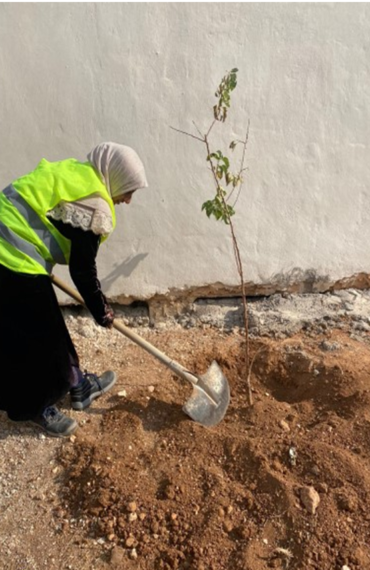
- Trainees were introduced to greywater treatment technologies and trained on how to safely reuse treated water in agriculture — demonstrated through actual installations in local buildings and gardens.
- Participants were equipped with essential skills such as CV writing, communication, digital literacy, and entrepreneurship, enhancing their readiness for the labor market.
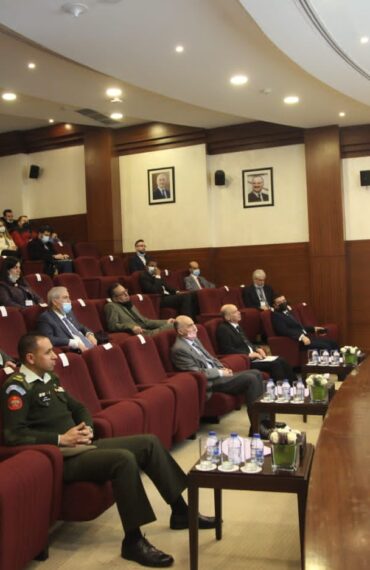
- The project promoted broader community awareness of sustainable water practices by conducting workshops in nine schools and developing tailored training materials, social media posts, and an awareness video.
Project Activities
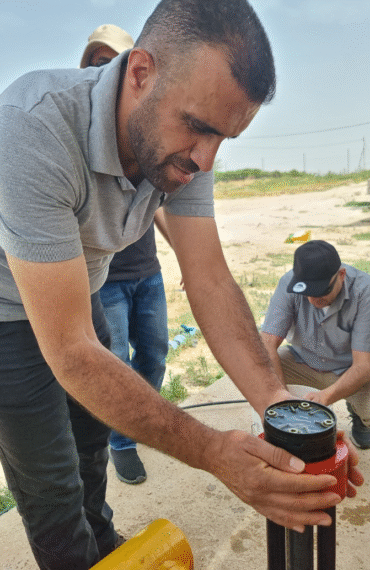
The ESWP project was designed to offer practical, hands-on training experience that directly responded to local livelihood needs and water management challenges. The project integrated four core training modules with real-life implementation, giving beneficiaries the opportunity to learn by doing. All technical fieldwork, including the installation of systems, was designed and executed by MIRRA in collaboration with partners. The primary intervention site — a residential building hosting Syrian refugee families in Ramtha — served both as a training ground and as a model for sustainable greywater reuse.
Key Activities:
- Site Assessments & Installations:
- Conducted initial field visits to assess the infrastructure needs of the selected residential building.
- Measured water flows from washing machines and evaluated the available space for system installation.
- Designed a customized greywater treatment and irrigation system, tailored to the needs of the building and its residents.
- Installation of the Greywater Treatment System
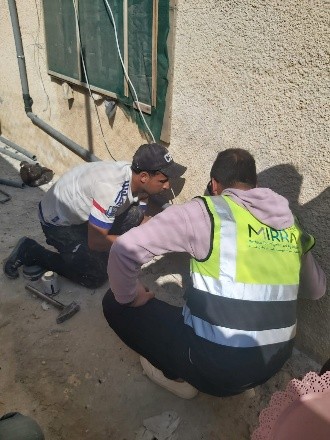
- MIRRA’s technical team oversaw excavation, construction, and connection of collection lines from washing machines to the treatment system.
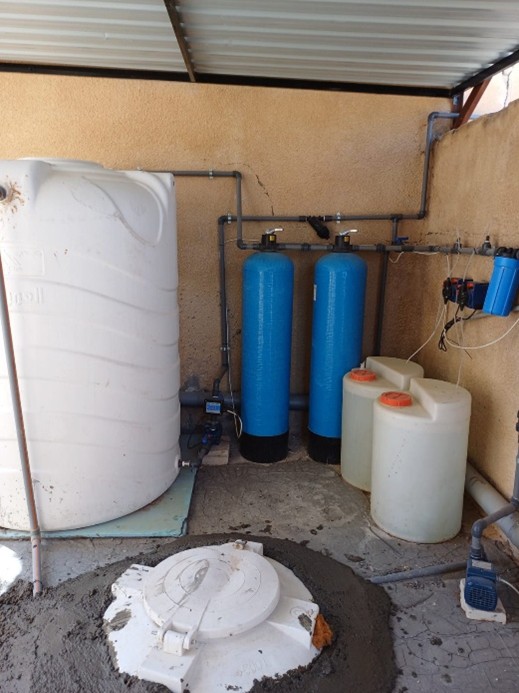
- Installed a multi-stage filtration system, designed to treat household greywater to a standard suitable for safe irrigation.
- Extended electrical connections and water delivery infrastructure to ensure reliable system operation.
- Conducted test runs to validate treatment efficiency and system durability.
- Installation of Irrigation Network
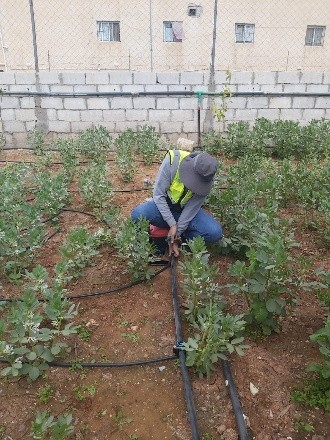
- Designed and installed a low-pressure irrigation system fed by the treated greywater.
- Laid irrigation lines across the building’s garden to demonstrate safe and productive reuse.
- The system now irrigates food and ornamental crops, providing long-term value to residents and serving as a practical demonstration site for trainees.
- Implementation of Four Training Modules
- Workshop 1: Plumbing Services (150 hours)
- Workshop 2: Greywater Treatment (30 hours)
- Workshop 3: Reuse of treated water in agriculture (40 hours)
- Workshop 4: Life skills, including CV writing and entrepreneurship (30 hours)
- Training Materials and Toolkits
- Developed and distributed Arabic-language training manuals customized to the literacy and technical background of participants (Tawjihi and diploma holders).
- Provided graduates with toolkits, uniforms, and printed guidelines to help them launch their own plumbing or greywater-related services.
- Community Awareness and Dissemination
- Shared project updates and visual documentation through MIRRA’s Facebook, LinkedIn, and YouTube platforms.
- Produced a short documentary video showing the system installation process and key training milestones.
- Engaged family members and neighbors of the beneficiaries in informal discussions about safe greywater reuse and local water-saving opportunities.
Project Impact According to OECD-DAC Evaluation Criteria
Project Relevance
The Empowerment Syrian Refugees Widows and Capacity Development in Plumbing, Gray Water Treatment, and Reuse in Agriculture (ESWP) project was highly relevant in addressing two pressing issues in northern Jordan:
- The socioeconomic vulnerability of Syrian refugee widows and underprivileged Jordanian youth, particularly in Ramtha and Irbid, where unemployment and poverty rates are among the highest in the country.
- The environmental urgency to manage water scarcity in Jordan — a country among the most water-deprived globally — where household water losses due to poor plumbing and low reuse of non-potable water exacerbate the problem.
The project targeted Syrian refugee widows, a marginalized group that faces structural barriers to employment, and underprivileged Jordanian youth, equipping them with practical, labor-market-oriented skills in plumbing, greywater treatment, and water reuse in agriculture. These are sectors that not only support household resilience but also contribute to Jordan’s national water strategy and green growth agenda.
The project directly aligns with the needs of these vulnerable populations and national development goals by:
- Building technical skills in plumbing, greywater treatment, and irrigation.
- Promoting water reuse, contributing to Jordan’s water security.
- Addressing gender equity by focusing on Syrian refugee widows as primary beneficiaries.
- Integrating green growth principles (plumbing, treatment, reuse) into capacity building programs.
Project Coherence
The ESWP project demonstrates internal and external coherence with national and donor priorities:
- National Alignment:
- It contributes to Jordan’s national strategies on water conservation, vocational training, and employment generation, particularly for women and youth.
- The project responds to key findings from national water studies, which show that improving plumbing and greywater management can significantly reduce household water loss.
- Donor Alignment:
The project is funded by the EDU-SYRIA program under the EU’s Madad Fund, and it directly supports its objectives: education access, livelihood development, and social cohesion for Syrian refugees and vulnerable Jordanians. - Partner Collaboration:
- The project integrates efforts from multiple partners: ASU (coordination and life skills), MIRRA (field implementation, training), Al Nashmeyah (plumbing), and Al Takful (beneficiary mobilization).
- This synergy avoided duplication and ensured each partner contributed its comparative strengths.
Project Effectiveness
The ESWP project effectively achieved its stated objectives:
- To build the technical and life skills capacities of Syrian refugee widows and underprivileged Jordanian youth.
- To promote self-reliance by equipping participants with vocational skills for income generation.
- To improve access to the labor market through practical, certified training and job readiness preparation.
Key Results:
- Trained 30 direct beneficiaries (20 Syrian refugee widows, 10 Jordanian youth) through four integrated training modules.
- Installed a fully functional greywater treatment and irrigation system in a residential building occupied by Syrian refugee families — a live demonstration site for trainees and a permanent utility for residents.
- Developed and delivered Arabic-language training materials, tailored for beneficiaries with Tawjihi or diploma-level education.
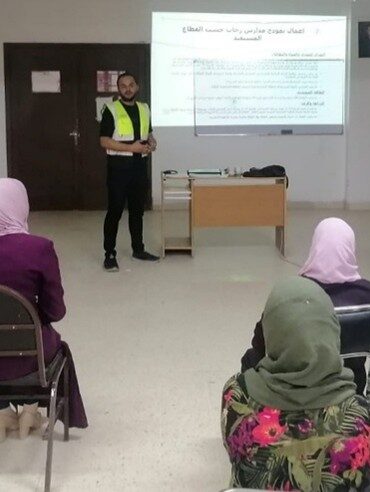
- Delivered training using both classroom sessions and hands-on implementation, improving retention and employability.
- Distributed certificates, toolkits, and uniforms to graduates to help them enter the labor market directly.
- Conducted pre- and post-training surveys showing clear improvements in knowledge, awareness, and system trust.
The project’s ability to deliver both skills development and infrastructure improvement confirms its strong effectiveness.
Project Efficiency
The project was implemented with a high degree of efficiency, considering the modest budget and its broad scope:
- Cost Optimization:
- Combining capacity building with physical infrastructure installation, maximizing the value of every activity.
- MIRRA’s leadership in implementation avoided third-party overheads and streamlined execution.
- Time Management:
Despite operational challenges and tight timelines (12 months), all key deliverables — training, system installation, awareness activities, and dissemination — were completed within the project period. - Monitoring and Reporting:
- A structured monitoring and evaluation plan was in place, including surveys, trainer feedback, and visual records.
- Social media and video documentation increased project visibility at minimal cost.
- MIRRA’s existing networks with the National Aid Fund and Syrian community leaders facilitated efficient identification and recruitment of eligible participants without costly outreach campaigns.
- The inclusion of soft-skill training through ASU’s existing infrastructure and trainers provided high value at minimal additional cost.
Moreover, trainees were divided into smaller groups to enhance learning efficiency and accommodate geographic spread, without compromising content quality. In summary, the project delivered substantial impact with minimal administrative burden, demonstrating high value for money.
Project Impact
The ESWP project created both tangible and intangible impacts at individual, household, and community levels:
Direct Impact on Beneficiaries:
- Graduates gained skills in plumbing, water treatment, and irrigation, positioning them for employment or self-employment.
- Participants received certificates and essential tools, enabling them to market themselves professionally.
- Syrian refugee widows gained confidence and social empowerment, moving closer to financial independence.
Impact on Host Community:
- The installed greywater system now supports a building with multiple refugee households, reducing freshwater demand and utility costs.
- Demonstrated the practical viability of treated greywater reuse, contributing to sustainable living models in vulnerable communities.
Institutional Impact:
- ASU and MIRRA strengthened their role as leaders in applied vocational training and water solutions.
- The project has become a model for replication within future EDU-SYRIA programs or other donor-funded initiatives.
In the longer term, the project is expected to contribute to better resource use in agriculture, improved water-use efficiency, and stronger local capacity for sustainable farming practices.
Project Sustainability
The ESWP project was carefully designed to ensure sustainability at multiple levels:
- Technical Sustainability:
- Beneficiaries were trained through direct involvement in the system’s design, installation, and operation — ensuring they can replicate or maintain such systems independently.
- The installed greywater and irrigation system will continue functioning for years, providing a real-world model for greywater reuse.
- Economic Sustainability:
- Graduates left the program with job-relevant skills, tools, and uniforms — reducing dependency on aid and opening access to income generation.
- The project promotes green employment, a growing sector in Jordan’s labor market.
- Institutional Sustainability:
- ASU will retain and update the vocational training manual, allowing the program to be repeated or expanded.
- MIRRA’s field leadership and technical documents serve as a blueprint for future greywater or WASH projects.
- Social Sustainability:
- WhatsApp groups and alumni networks promote ongoing peer learning and collaboration.
- Syrian refugee widows who benefited are likely to share their skills within their communities, promoting informal diffusion.
- Established partnerships with employers and institutions like ASU, National Aid Fund, and others create a support network for future initiatives.
- Gender-sensitive design, inclusive selection processes, and the focus on underserved communities build trust and long-term engagement with local populations.
- MIRRA’s follow-up mechanisms, including its Complaints and Response Mechanism (CRM) and internal M&E framework, contribute to long-term accountability and learning.
Stakeholder Engagement with Strategic Groups
Project Beneficiaries
The ESWP project strategically targeted and served both direct and indirect beneficiaries, focusing on highly vulnerable populations in northern Jordan — particularly Ramtha and Irbid, areas with a high concentration of Syrian refugees and economically marginalized Jordanian youth.
Direct Beneficiaries:
- Direct Beneficiaries: 30 individuals
- 20 Syrian refugee widows residing in Ramtha.
- 10 underprivileged Jordanian youth, with a focus on unemployed women
- Beneficiaries were selected through a structured process led by Al Takful, in cooperation with local community leaders and based on clear criteria:
- Female-headed households
- Aged between 19–28
- Monthly income below 250 JOD
- Minimum educational background of Tawjihi or diploma holders
- Interest or potential in vocational training and labor market integration
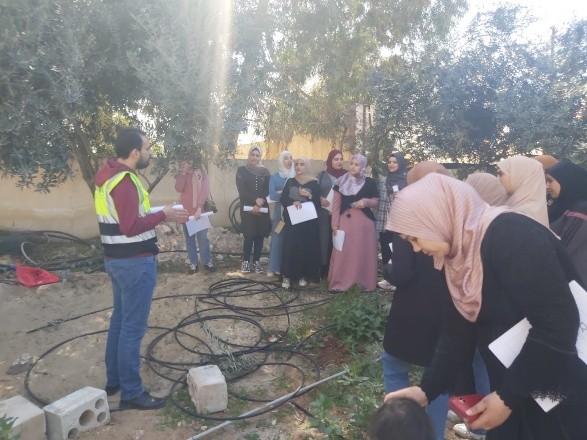
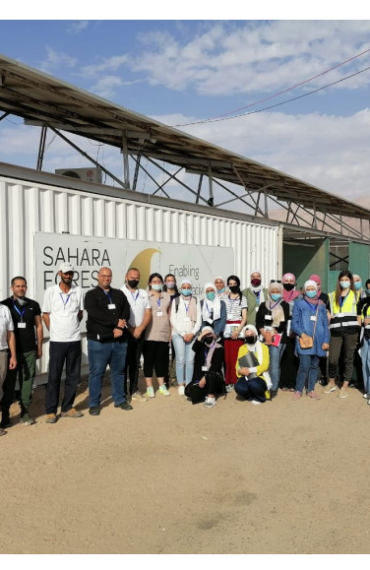
These individuals participated in a comprehensive 4-module training program (plumbing, greywater treatment, reuse in agriculture, and life skills), receiving both theoretical instruction and hands-on learning in a real system installed at a residential building housing refugee family.
Indirect Beneficiaries:
- Estimated 175 individuals
- 120 from the families of the 20 Syrian refugee widows
- 55 from the families of the 10 Jordanian youth
- These beneficiaries benefited indirectly through:
- Improved household income potential
- Access to treated greywater for crop irrigation
- Greater awareness of sustainable water use practices
Project Engagement with Women
The ESWP project was explicitly designed to prioritize women’s empowerment, particularly Syrian refugee widows, who are often excluded from labor markets due to cultural norms, lack of education, and caregiving responsibilities.
- Strategic Focus on Female Beneficiaries
- Women made up over 66% of the direct beneficiaries (20 out of 30 participants were Syrian refugee widows).
- The project prioritized female-headed households and economically vulnerable women based on their family responsibilities and income levels.
- Engagement was based on pre-project interviews and community assessments, which revealed the acute need among widows for both income and technical training.
- Tailored Training and Support for Women
- Training sessions were designed with gender sensitivity, including:
- Female trainers when appropriate
- Mixed-gender facilitation teams to respect cultural norms
- Safe and accessible training locations (MIRRA’s lab, ASU campus, and local centers)
- Life skills and entrepreneurship sessions emphasized communication, digital literacy, and self-employment, helping women navigate formal and informal labor markets.
- Beneficiaries were provided with:
- Uniforms and toolkits
- Official certificates enabling them to work in the local market or start small plumbing services.
- Women formed peer support groups via WhatsApp, fostering continued learning, shared problem-solving, and emotional support after the training ended
- Social Empowerment Outcomes:
- The program helped increase confidence and autonomy among participants.
- Refugee widows reported a stronger sense of social inclusion and purpose.
- It created pathways for women to generate independent income, reducing dependence on aid or male relatives.